each row is a document, each column is a question, each cell is an answer linked to evidence
You bring the codebook and the documents. Data Mint makes the data.
@karlrohe
The chain has three parts, and the first two are yours. You have a codebook. You have some documents. For every document you fill out the codebook answers and put them in a spreadsheet.
I claim it works for any collection of documents and any codebook. I am sure we can come up with counterexamples where it will not work. I am interested in those.
Reading here is not only text. I say reading again and again, and the models are multimodal. Extract data from clinical-trial papers and the numbers you want are in tables and figures. Those are visual. Data Mint has Visual for that, and there are vision models that will read them.
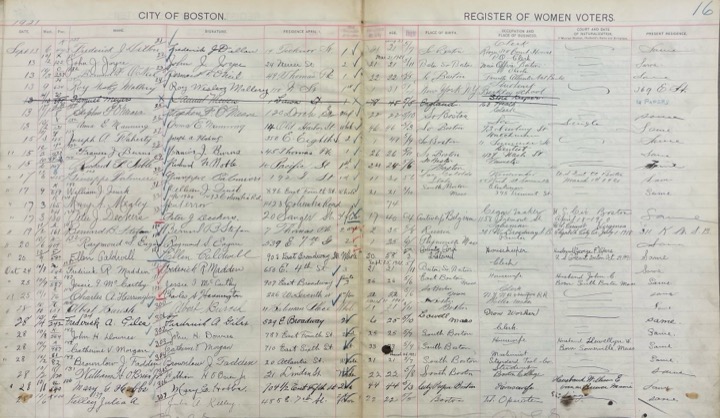
A document can be a page of cursive in a bound volume. I am working with a project that has scans of historical ledgers. People writing by hand, in huge books, registering women to vote in Boston in the 1920s. It is beautiful script.
A 1920s Boston voter-registration ledger. Cursive, in a bound volume. A crazy example of a codebook and documents.1
1City of Boston, Register of Women Voters, 1921 (ward 10, vol. 1A). Page-level view; names not legible at this size.
New problems arise in these cases, and those are the ones I am most interested in. Data Mint handles that class of document under the name Squint. The abstraction does not change. You need a codebook, and you have documents.