The demand for reading keeps growing. The reader has always been human.
Read documents. Produce structured data. The task is everywhere — and the demand is growing.
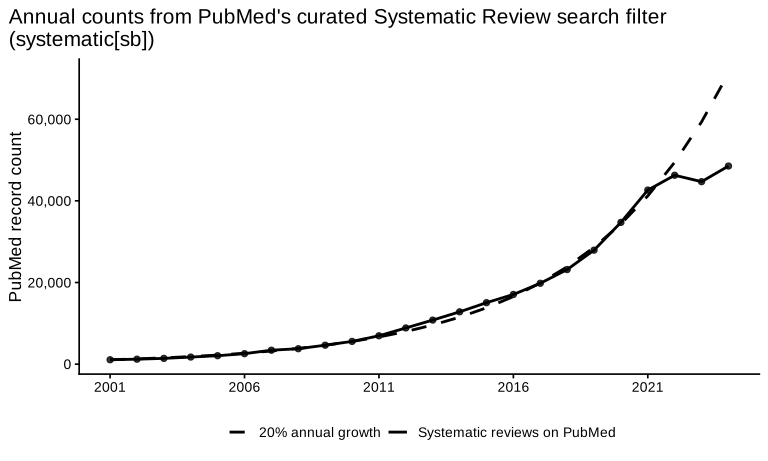
One example: PubMed's systematic-review count, ~20% growth per year. source: PubMed "Systematic Review" filter
130per day indexed
~20%annual growth
1,000+hours per review
6–18months typical
Skilled human readers screen, extract, and code — double-coded to catch disagreement. Same labor, same bottleneck, across domains:
Legal discoveryprivilege, responsiveness
Chart reviewdiagnostic codes
Interview codingrecurring themes
Patent examinationclaims, citations
FOIA investigationactors, dates, actions
Historical archivespeople, places, events
The reader has always been human. What if the reader could be AI?
@karlrohe
The demand for reading doubles every few years, in every field that counts it. Systematic reviews count. PubMed indexes about 130 a day. The count grows about twenty percent a year, a doubling every four years. Each review still takes a team a thousand hours. Most fields count less carefully. Where they count, the curve has the same shape. Back of the envelope:
Journal articles, ~11-year doubling time. Crossref indexes 1.7 million in 2004, 3.2 million in 2014, 6.1 million in 2024.1
Registered trials, ~11-year doubling time. First posted on ClinicalTrials.gov: 23,000 in 2014, 44,000 in 2024.2
FOIA requests, ~10-year doubling time, and accelerating. 558,000 in fiscal 2009, 1.7 million in fiscal 2025; the last two years were the two biggest jumps on record.3
Patent applications, ~20-year doubling time. Worldwide: 2.7 million in 2014, 3.7 million in 2024.4
Adverse-event reports. FAERS takes in about a million a year, each one a narrative someone codes.5
Digitized archive pages, ~3-year doubling time. The US National Archives had 150 million pages online in 2021 and 326 million in 2024, against 13 billion still on paper.6
The clinical note itself, ~8-year doubling time. At one academic center the median progress note went from 1,530 characters in 2006 to 3,838 in 2016.7 The charts got longer while the chart reviews multiplied. Now AI scribes draft the note, and it is about to get much longer.
Expect these doubling times to get shorter. Language models are now doing more of this reading. They are also doing more of the writing that makes the documents in the first place. Every number above was measured before that.
Every one of those is a pile someone reads to answer a question. Does this study qualify? What was the dose? Is this record responsive? Has this claim been made before? The piles come in two shapes.
definitions
corpus — the collection of documents you mint: every document a data point. The trials a review screened. The charts a hospital audited. The letters in a box in an archive.
batch — a corpus you have all of, coded once. An archive, a literature search.
stream — a corpus that keeps arriving, each document coded as it lands. Incident reports, adverse-event narratives, intake notes, comments on a proposed rule.
The reading is not always extraction. Often it is triage: you mint an input corpus to decide which documents belong in the target corpus you actually care about. Is this the high-risk case? Does a person need to see this one? Screening is the familiar version, and the same move runs anywhere the pile is bigger than the question.
Eleven shapes the pile takes, with the kind of question asked of each. Illustrative, not anyone's project:
Two thousand abstracts from a database search. Is this a randomized trial in our population?
Four hundred trial registrations. Is the primary outcome specified tightly enough to pin down the estimand?
A drawer of preregistrations and their published papers. Did the analysis change, and did they say so?
Nine hundred open-ended survey responses. Which of our twelve themes does this one touch, and in what tone?
Sixty interview transcripts. Where does the speaker describe a decision they regret?
A county's bankruptcy filings, scanned. Who is the creditor, what is owed, and is there a wage garnishment?
A nineteenth-century city ledger, handwritten, scanned page by page. Who was paid, how much, and for what?
A century of a newspaper's letters to the editor. What is the writer asking the town to do?
Every dissent a court issued in a decade. What doctrine does the dissenter say the majority got wrong?
Adverse-event narratives for one drug class. Was the reaction on the label, and who reported it?
Twelve thousand clinical notes for a registry. Was the outcome assessor blinded? Was the dose recorded?
If you have a pile like that and a question you keep asking of it, this series is about your project. The about page collects the range of what people are already doing with the tool, and people often find there a project they had written off as too much reading.